I’ve started writing on Substack. Do have a look and subscribe to receive the stories as soon as they are published. No paywalls, no paid content – it’s all free. See you there!
News
Meet Meena!
Posted on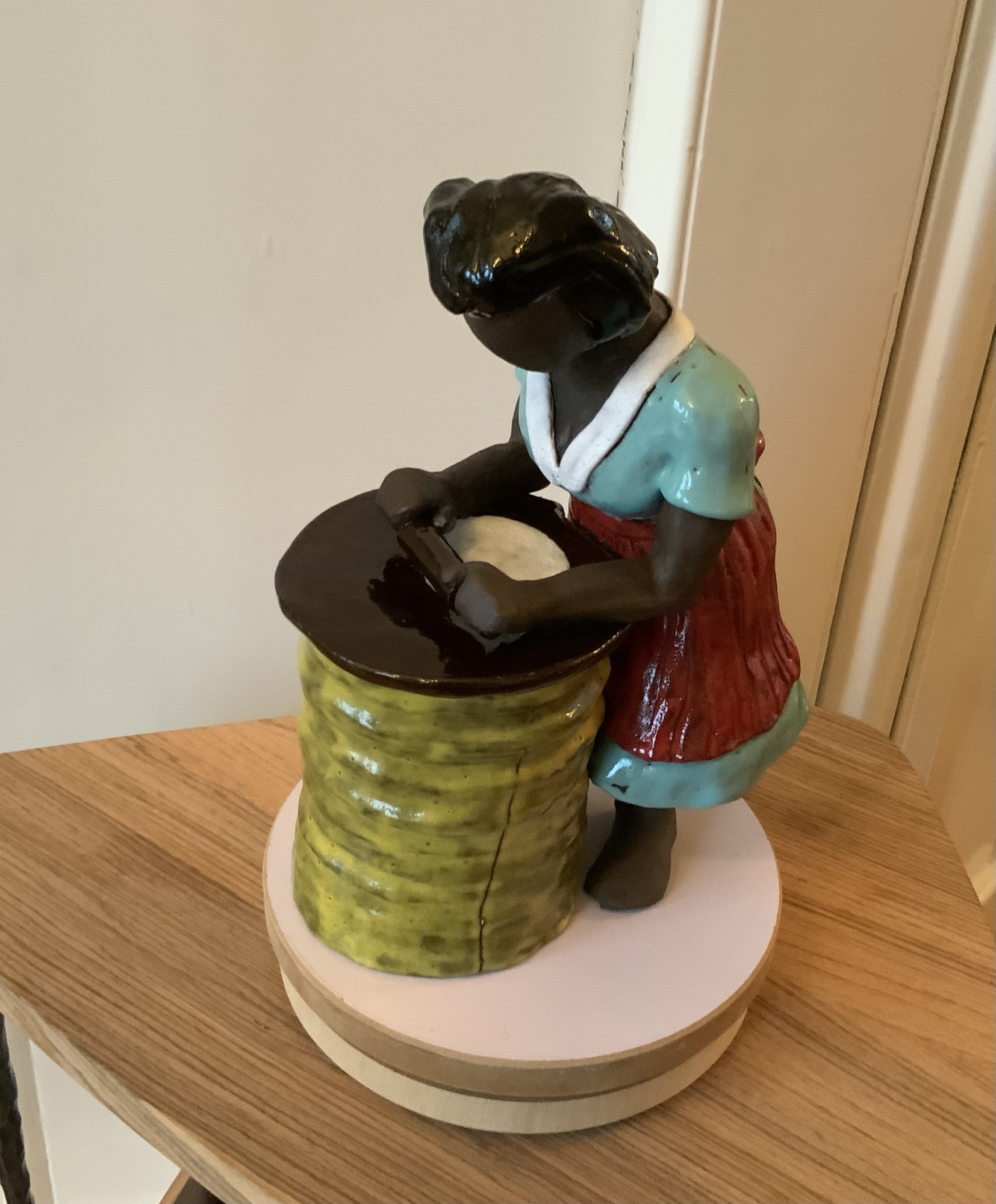
What do you see? A ceramic figurine of a dark-complexioned woman who is standing in front of a dented old oil drum doing something? Oh wait! She has a rolling pin in her hand and seems to be rolling out some kind of dough. Well, you’re absolutely correct. But there is a lot more to this figurine than meets the fleeting eye.
Like all of my Kiskadee Days and Kiskadee Village ceramic sculptures, Meena embodies a chunk of cultural history. Let’s peel back a few layers.
Meena is the descendant of Indian indentured labourers who were taken to work on the sugar plantations of British Guiana. Her ancestors would have been offered the choice of a return passage to India when their contract expired, or a modest land grant. Many chose to remain in the colony and generations later came people like Meena – and me.
They remained largely in rural communities, often near to a sugar estate where they were able to get jobs. Everyday food was basic and based on availability. In a self-sufficient village there would be vegetables from the kitchen gardens, fish from the ponds and trenches, and on more special occasions a home-reared fowl or duck. Very special occasions called for a sheep to be butchered in a Hindu family, while Muslims and Christians might prefer beef. Larger communities near to sugar estates had markets that offered more variety. The indentured labourers and their descendants would, for generations, continue to use Bhojpuri Hindi words in everyday speech, particularly when related to food and cooking.
Getting back to Meena: she is rolling out roti. Paratha, commonly known as ‘oil roti’. The simple dough is rolled out into a thin circle after a short resting period, generously oiled and sprinkled with flour, then a slit is made from the rim to the centre and it is coiled to form a cone. The tip of the cone is pressed inwards to make a navel. These ‘loi’ as they are called in Guyana, are left to rest for while before being rolled out and cooked on a tawa, a flat iron griddle. The job is not quite done, though. The cooked roti is lifted off the tawa at the right moment, when there are just a few golden flecks on its surface, then flung into the air and retrieved with a clapping motion, flakes flying in all directions. After a few flings and claps, the roti loosens up beautifully into the layers that were created by the cone and can be peeled apart into soft and silky fragments. I believe that some people nowadays have taken to putting the roti into a large jug and shaking it vigorously to loosen the layers. It saves your hands but it won’t be the same as a clapped roti. There is a middle road: put the hot roti in a teatowel and then clap it. No flying flakes, no burnt hands. But no fun either.
The old oil drum here, which the villagers call a puncheon, is now so dented and cracked that it’s no longer fit to hold water. It’s still too good to throw away, though. It has been repurposed into a makeshift table and stands in the bottomhouse near the chulha (clay stove also called a fireside). The smooth wooden top makes an excellent rolling surface so there is no need to bring down the chowki (rolling/pastry board) from the proper kitchen upstairs. Meena’s belna (rolling pin) flies back and forth as she expertly produces perfectly round roti every time. No maps of Trinidad here!
From Meena: “Fry bora wid aloo an saalfish done cook. And dis ah de laas loi mih roll out. Now mih cyan ress lil bit before mih husban an dem chirren come home. Mih guh siddung in de hammack an read de Mills an Boon mih baarrow from Liloutie. Mih weary!”
Note that Kiskadee Days is set in the 1960s and 1970s. It was a totally different life back then and cannot be compared to life in modern Guyana. It no longer exists
University of Guyana launches Kiskadee Days Village People
Posted on
Forever Sifting
Posted onA poem in prose
by Gaitri Pagrach-Chandra
Strange men came to the starving village where the crops had once more failed.
“Come,” they told Etwaria’s grandmother. “Come with us. We will take you on a big ship across the water to a new future. A good future. You will sift sugar and earn money. Plenty money! After 5 years you can board the ship again. You will return here, a rich woman. Rich-rich! You only have to sift some sugar.”
She went with them.
There was nothing to keep her there, in that hot and dusty place. She was just another mouth to feed. They would be better off without her. With her, she took her mother’s big chalni. To sift that sugar. Plenty sugar so they would pay her plenty money. She would buy a brand new chalni for her mother when she came back.
The voyage seemed endless.
But one scorching afternoon the blue sea started to turn brown. They saw land. Full of excitement and expectation she arrived with her chalni at the plantation where she was bound. The people there laughed at her because they knew. The men had been to their starving villages too. “Sister, put away that chalni! You will not need it here. They will give you a cutlass and send you to the canefields with the rest of us.”
She sighed; she stayed; she worked.
They all did. She married a man who was kind on most days and unkind on the days he drank. Together, they raised a family. She told her grandchildren tales of worse struggles in a far-off land. A land that still tugged at her heart although her life now lay in the colony. The colony whose rich soil held her children’s and grandchildren’s navel strings.
Etwaria’s own grandchildren would come in time.
And they would go. They too would go across the water to a new future. A different water, a different future. Some would go eagerly, other reluctantly. They would learn to sift. They would sift good from bad, positive from negative, warmth from cold, hope from despair. All would feel the pull of the far-off land on the muddy shores of the Atlantic. A different land, a different pull. The call of the kiskadee would never leave them.
Text and ceramic sculpture © Gaitri Pagrach-Chandra www.kiskadeedays.com
2018 Godfrey Chin Prize for Heritage Journalism
Posted onTowards the end of July I received an email congratulating me and the ladies of Kiskadee Village, and informing me that I had been awarded the 2018 Godfrey Chin Prize for Heritage Journalism. I was bowled over! When the official announcement came a few days later it said the following:
“THE GODFREY CHIN PRIZE FOR HERITAGE JOURNALISM
Ms. Gaitri Pagrach-Chandra (First Prize)
For “The Wedding” sequences in Kiskadee Days. The sequences were published weekly on Facebook from Friday May 25, 2018 to Friday, June 29, 2018.
Kiskadee Days is set in a rural Guyanese community. It is a community of ceramic sculptures created by Guyana-born, Netherlands-based, Gaitri Pagrach-Chandra. It is an innovation in Guyanese storytelling. Her sculptures, her “Ladies” – among them are Ajie, Aunty Jessie, Miss Bhagwattie Singh, Bhougie, Bibi, Claudette, Dulari, Ethel, Indrani, Jasoda, Lily-Gal, Mabel, Mavis, Miss Phoenix, Mudder Melrose, Parbati, Pearl, Sitira and Shanta. The sculptures are the vehicles through which she shares her recollections about her childhood in Guyana’s sugar belt. Starting on Friday, May 25, 2018 and ending on Friday, June 29, her ladies provided an authentic, informative and witty examination of a Hindu wedding in Guyana. These six episodes provided an accessible exploration of a major aspect of Guyanese cultural life. It is a valuable contribution to understanding and harmony. Kiskadee Days embodies all of Godfrey’s attributes and advances all the core values GCA considers when determining awards – originality, scope, impact/influence, contribution to harmony, innovation, and creativity.”
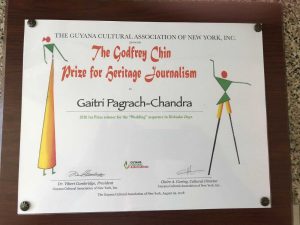
I decided to travel to New York at the end of August to receive my prize at the Guyana Cultural Association’s annual Awards evening, which was held in great style at the Brooklyn Borough Hall. It was a wonderful event, with awards, speeches, song, dance, music, food and great people. You can watch the entire ceremony via the following link https://kiskadeedays.com/2018/07/21/award-show-the-godfrey-chin-prize-for-heritage-journalism/ The Godfrey Chin Prize starts at about 50 minutes, for those who have little patience to watch it all.
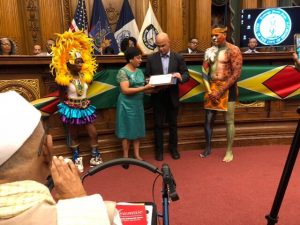
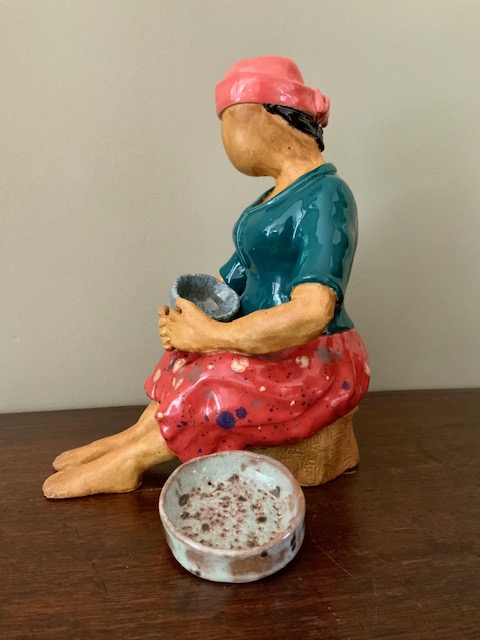
After my acceptance speech, I had a special surprise for the GCA. I had brought Sitira with me and officially presented her to the Guyana Cultural Center in New York, to be a permanent part of their collection. She will represent Kiskadee Village in New York and the Kiskadee ladies and I hope that she will bring pleasure to many. We will miss her physical presence, but she will remain with us in spirit and we hope to hear how she is faring in ‘farrin’, such a long way from her bamboo dam.